François Libert, Frankreich


Info
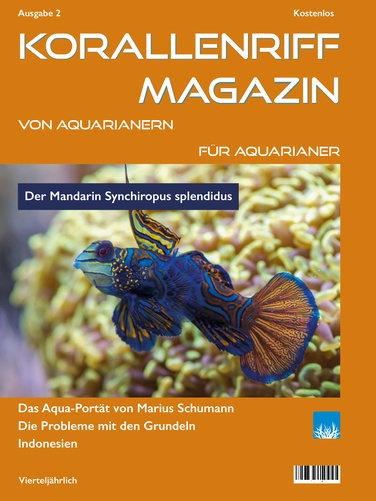
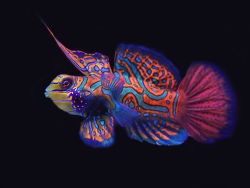
Synchiropus splendidus, Herre, 1927
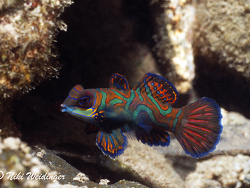
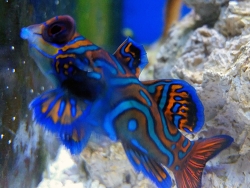
The mandarin fish Synchiropus splendidus is placed in the genus Synchiropus within the lyrefish family (Callionymidae). Instead of scales, the mandarin fish has a firm and very slimy skin, which then gives off a foul odor when the fish comes up for air. This layer of mucus on the skin is thought to protect the fish from disease and enemies. Lyrefish do not float or swim like other fish, but move slowly gliding along using their pelvic fins.
Aquarium husbandry recommendation:
This fish can only be kept in well run-in tanks, as it lives on micro animals found in the substrate and on rocks. If you have a well acclimated tank, then there are no problems with feeding. This should be taken to heart.
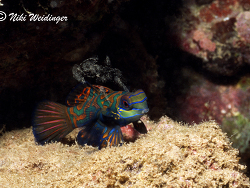
It is not sensitive to diseases at all. You can recognize the male by the longer first dorsal fin (looks like a small sword) - see picture gallery below.In no case bring two males in one tank, because they would fight each other until death.
Keeping pairs is no problem, even desired. The animals perform a regular courtship dance by rising to the water surface. This is really wonderful to watch.
Feeding intake.
The fish take a long time to eat at the beginning, before the food is taken up, a close inspection is carried out. After acclimatisation, the offered frozen food is eaten without problems. It should be noted that wild-caught fish behave differently than offspring when it comes to food intake. In the case of offspring, the size of the fish purchased also plays a role in the choice of food.
Pool requirement.
The tank volume specified above is less relevant. What is important is that there is enough or suitable food in the tank, because they have to eat constantly and survive without supplementary feeding in well-worn tanks with several months of standing time and correspondingly well-developed microfauna. During this time, they feed on micro-animals found in the substrate and on the stones. There must be enough bottom surface for successful maintenance.
Furthermore, food competitors are also important (e.g. pipefish, small wrasses, etc. or by keeping them in pairs), which chase the limited live food on the substrate. It is also advantageous to keep a small copepod farm (several boxes) in the beginning. After switching to frozen food, live food breeding can be discontinued.
Live benethic (bottom-living) copepods - Tigriopus californicus or Tisbe biminiensis - can always be added if available.
Unfortunately, there is no guarantee that the switch from live food to frozen food will be successful. In this case, extensive live food breeding is necessary for our fish to survive in the aquarium.
There are exceptions that they go to frozen food. However, unfortunately not every Mandarin goes to frozen food, so that it should not be so fresh basins.
We can not share the information of FishBase about 6 cm size, because our fish was already two centimeters bigger.
Breeding information.
The rearing of Synchiropus splendidus larvae has been successful with Acartia (Acanthacartia) tonsa. The nauplii of Acartia are very small (70 µm) and pelagic (free-swimming).
The breeder Wolfang Mai has already succeeded in breeding Synchiropus splendidus. Source: Wolfgang Mai: Lyrefish in the marine aquarium: care and breeding. NTV Nature and Animal Publishing House, 2009
Synonyms:
Callionymus splendidus Herre, 1927
Neosynchiropus splendidus (Herre, 1927)
Pterosynchiropus splendidus (Herre, 1927)
The term "reef safe" is often used in marine aquaristics, especially when buying a new species people often ask if the new animal is "reef safe".
What exactly does reef safe mean?
To answer this question, you can ask target-oriented questions and inquire in forums, clubs, dealers and with aquarist friends:
- Are there already experiences and keeping reports that assure that the new animal can live in other suitably equipped aquariums without ever having caused problems?
- Is there any experience of invertebrates (crustaceans, hermits, mussels, snails) or corals being attacked by other inhabitants such as fish of the same or a different species?
- Is any information known or expected about a possible change in dietary habits, e.g., from a plant-based diet to a meat-based diet?
- Do the desired animals leave the reef structure "alone", do they constantly change it (boring starfish, digger gobies, parrotfish, triggerfish) and thus disturb or displace other co-inhabitants?
- do new animals tend to get diseases repeatedly and very quickly and can they be treated?
- Do known peaceful animals change their character in the course of their life and become aggressive?
- Can the death of a new animal possibly even lead to the death of the rest of the stock through poisoning (possible with some species of sea cucumbers)?
- Last but not least the keeper of the animals has to be included in the "reef safety", there are actively poisonous, passively poisonous animals, animals that have dangerous biting or stinging weapons, animals with extremely strong nettle poisons, these have to be (er)known and a plan of action should have been made in advance in case of an attack on the aquarist (e.g. telephone numbers of the poison control center, the treating doctor, the tropical institute etc.).
If all questions are evaluated positively in the sense of the animal(s) and the keeper, then one can assume a "reef safety".
The mandarin fish Synchiropus splendidus is placed in the genus Synchiropus within the lyrefish family (Callionymidae). Instead of scales, the mandarin fish has a firm and very slimy skin, which then gives off a foul odor when the fish comes up for air. This layer of mucus on the skin is thought to protect the fish from disease and enemies. Lyrefish do not float or swim like other fish, but move slowly gliding along using their pelvic fins.
Aquarium husbandry recommendation:
This fish can only be kept in well run-in tanks, as it lives on micro animals found in the substrate and on rocks. If you have a well acclimated tank, then there are no problems with feeding. This should be taken to heart.
It is not sensitive to diseases at all. You can recognize the male by the longer first dorsal fin (looks like a small sword) - see picture gallery below.In no case bring two males in one tank, because they would fight each other until death.
Keeping pairs is no problem, even desired. The animals perform a regular courtship dance by rising to the water surface. This is really wonderful to watch.
Feeding intake.
The fish take a long time to eat at the beginning, before the food is taken up, a close inspection is carried out. After acclimatisation, the offered frozen food is eaten without problems. It should be noted that wild-caught fish behave differently than offspring when it comes to food intake. In the case of offspring, the size of the fish purchased also plays a role in the choice of food.
Pool requirement.
The tank volume specified above is less relevant. What is important is that there is enough or suitable food in the tank, because they have to eat constantly and survive without supplementary feeding in well-worn tanks with several months of standing time and correspondingly well-developed microfauna. During this time, they feed on micro-animals found in the substrate and on the stones. There must be enough bottom surface for successful maintenance.
Furthermore, food competitors are also important (e.g. pipefish, small wrasses, etc. or by keeping them in pairs), which chase the limited live food on the substrate. It is also advantageous to keep a small copepod farm (several boxes) in the beginning. After switching to frozen food, live food breeding can be discontinued.
Live benethic (bottom-living) copepods - Tigriopus californicus or Tisbe biminiensis - can always be added if available.
Unfortunately, there is no guarantee that the switch from live food to frozen food will be successful. In this case, extensive live food breeding is necessary for our fish to survive in the aquarium.
There are exceptions that they go to frozen food. However, unfortunately not every Mandarin goes to frozen food, so that it should not be so fresh basins.
We can not share the information of FishBase about 6 cm size, because our fish was already two centimeters bigger.
Breeding information.
The rearing of Synchiropus splendidus larvae has been successful with Acartia (Acanthacartia) tonsa. The nauplii of Acartia are very small (70 µm) and pelagic (free-swimming).
The breeder Wolfang Mai has already succeeded in breeding Synchiropus splendidus. Source: Wolfgang Mai: Lyrefish in the marine aquarium: care and breeding. NTV Nature and Animal Publishing House, 2009
Synonyms:
Callionymus splendidus Herre, 1927
Neosynchiropus splendidus (Herre, 1927)
Pterosynchiropus splendidus (Herre, 1927)
The term "reef safe" is often used in marine aquaristics, especially when buying a new species people often ask if the new animal is "reef safe".
What exactly does reef safe mean?
To answer this question, you can ask target-oriented questions and inquire in forums, clubs, dealers and with aquarist friends:
- Are there already experiences and keeping reports that assure that the new animal can live in other suitably equipped aquariums without ever having caused problems?
- Is there any experience of invertebrates (crustaceans, hermits, mussels, snails) or corals being attacked by other inhabitants such as fish of the same or a different species?
- Is any information known or expected about a possible change in dietary habits, e.g., from a plant-based diet to a meat-based diet?
- Do the desired animals leave the reef structure "alone", do they constantly change it (boring starfish, digger gobies, parrotfish, triggerfish) and thus disturb or displace other co-inhabitants?
- do new animals tend to get diseases repeatedly and very quickly and can they be treated?
- Do known peaceful animals change their character in the course of their life and become aggressive?
- Can the death of a new animal possibly even lead to the death of the rest of the stock through poisoning (possible with some species of sea cucumbers)?
- Last but not least the keeper of the animals has to be included in the "reef safety", there are actively poisonous, passively poisonous animals, animals that have dangerous biting or stinging weapons, animals with extremely strong nettle poisons, these have to be (er)known and a plan of action should have been made in advance in case of an attack on the aquarist (e.g. telephone numbers of the poison control center, the treating doctor, the tropical institute etc.).
If all questions are evaluated positively in the sense of the animal(s) and the keeper, then one can assume a "reef safety".