steff300680


Info
Zebrasoma flavescens (Bennett, 1828)
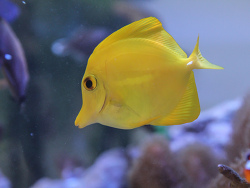
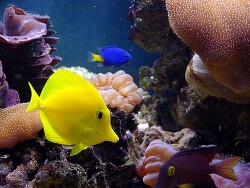
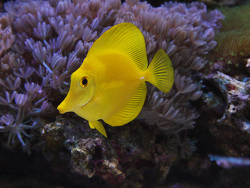
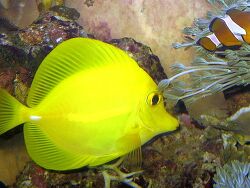
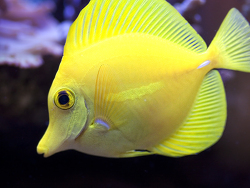
The Yellow Tang or Lemon Sailfin Tang is one of the most popular fish among reef keepers. Its bright yellow colouring as well as its hardiness compared to other surgeonfish makes the Yellow tang very often to be the first choice for beginners in the saltwater hobby when they want to add a surgeonfish to their tank.
The Yellow Tang is a rather docile fish and may be kept – provided the tank is large enough and its reef setting is well structured providing a lot of crevices and caves - with other surgeonfish species and in pairs. If you intend to keep a pair of Yellow Tangs or Yellow Tangs together with other surgeonfish it is best to introduce them at the same time.
Due to its natural appetite for filamentous algae the Yellow Tang helps to keep undesired algae at bay. Besides this natural food source Yellow Tangs should be fed a predominantly herbivore diet consisting of different sorts of fresh or dried macroalgae , e. g. Nori, Wakame, Ulva fasciata supplemented by some frozen fare, e.g. krill, mysid shrimps. The frozen food should be enriched with vitamins occasionally.
As a grazing species surgeonfish feed nearly continuously during the day. In captivity continuous feeding may be a bit difficult, but you should at least feed your tang two or three times a day and in addition provide it with algae leaves attached to a clip or wrapped around small “feeding rocks”.
Yellow Tangs, especially juveniles, are quick to suffer from improper and insufficient feeding. The arising nutrional disorders make them very susceptible to parasitic and bacterial diseases.
The Yellow Tang is the number one collected fish for export out of Hawaiii.
Synonym:
Acanthurus flavescens Bennett, 1828
Classification: Biota > Animalia (Kingdom) > Chordata (Phylum) > Vertebrata (Subphylum) > Gnathostomata (Superclass) > Pisces (Superclass) > Actinopterygii (Class) > Perciformes (Order) > Acanthuridae (Family) > Acanthurinae (Subfamily) > Zebrasoma (Genus)
The surgeonfishes (Acanthuridae), popular in marine aquaristics, are also called surgeonfishes.
They have horn-like blades in front of the tail root, they use as mainly defensive weapon (defense) against predators, but this sharp weapon is also used in fights among themselves.
Deep cuts in the body of opponents can cause permanent injuries, but often death occurs immediately.
If surgeonfishes are to be kept in pairs in an aquarium, fights between the fishes can be the order of the day, we could observe this several times with the very popular Hawaiian surgeonfish (Zebrasoma flavescens).
The scalpel-like blades can cause deep cuts, this is also true for the careless aquarist who wants to touch or catch the fish with unprotected hands.
Another problem can occur if one wants to catch surgeonfish with a landing net and transfer them after catching, the horn blade can easily get caught in the net.
Caution: Careless handling of the animal can cause deep cuts!
The term "reef safe" is often used in marine aquaristics, especially when buying a new species people often ask if the new animal is "reef safe".
What exactly does reef safe mean?
To answer this question, you can ask target-oriented questions and inquire in forums, clubs, dealers and with aquarist friends:
- Are there already experiences and keeping reports that assure that the new animal can live in other suitably equipped aquariums without ever having caused problems?
- Is there any experience of invertebrates (crustaceans, hermits, mussels, snails) or corals being attacked by other inhabitants such as fish of the same or a different species?
- Is any information known or expected about a possible change in dietary habits, e.g., from a plant-based diet to a meat-based diet?
- Do the desired animals leave the reef structure "alone", do they constantly change it (boring starfish, digger gobies, parrotfish, triggerfish) and thus disturb or displace other co-inhabitants?
- do new animals tend to get diseases repeatedly and very quickly and can they be treated?
- Do known peaceful animals change their character in the course of their life and become aggressive?
- Can the death of a new animal possibly even lead to the death of the rest of the stock through poisoning (possible with some species of sea cucumbers)?
- Last but not least the keeper of the animals has to be included in the "reef safety", there are actively poisonous, passively poisonous animals, animals that have dangerous biting or stinging weapons, animals with extremely strong nettle poisons, these have to be (er)known and a plan of action should have been made in advance in case of an attack on the aquarist (e.g. telephone numbers of the poison control center, the treating doctor, the tropical institute etc.).
If all questions are evaluated positively in the sense of the animal(s) and the keeper, then one can assume a "reef safety".
The Yellow Tang or Lemon Sailfin Tang is one of the most popular fish among reef keepers. Its bright yellow colouring as well as its hardiness compared to other surgeonfish makes the Yellow tang very often to be the first choice for beginners in the saltwater hobby when they want to add a surgeonfish to their tank.
The Yellow Tang is a rather docile fish and may be kept – provided the tank is large enough and its reef setting is well structured providing a lot of crevices and caves - with other surgeonfish species and in pairs. If you intend to keep a pair of Yellow Tangs or Yellow Tangs together with other surgeonfish it is best to introduce them at the same time.
Due to its natural appetite for filamentous algae the Yellow Tang helps to keep undesired algae at bay. Besides this natural food source Yellow Tangs should be fed a predominantly herbivore diet consisting of different sorts of fresh or dried macroalgae , e. g. Nori, Wakame, Ulva fasciata supplemented by some frozen fare, e.g. krill, mysid shrimps. The frozen food should be enriched with vitamins occasionally.
As a grazing species surgeonfish feed nearly continuously during the day. In captivity continuous feeding may be a bit difficult, but you should at least feed your tang two or three times a day and in addition provide it with algae leaves attached to a clip or wrapped around small “feeding rocks”.
Yellow Tangs, especially juveniles, are quick to suffer from improper and insufficient feeding. The arising nutrional disorders make them very susceptible to parasitic and bacterial diseases.
The Yellow Tang is the number one collected fish for export out of Hawaiii.
Synonym:
Acanthurus flavescens Bennett, 1828
Classification: Biota > Animalia (Kingdom) > Chordata (Phylum) > Vertebrata (Subphylum) > Gnathostomata (Superclass) > Pisces (Superclass) > Actinopterygii (Class) > Perciformes (Order) > Acanthuridae (Family) > Acanthurinae (Subfamily) > Zebrasoma (Genus)
The surgeonfishes (Acanthuridae), popular in marine aquaristics, are also called surgeonfishes.
They have horn-like blades in front of the tail root, they use as mainly defensive weapon (defense) against predators, but this sharp weapon is also used in fights among themselves.
Deep cuts in the body of opponents can cause permanent injuries, but often death occurs immediately.
If surgeonfishes are to be kept in pairs in an aquarium, fights between the fishes can be the order of the day, we could observe this several times with the very popular Hawaiian surgeonfish (Zebrasoma flavescens).
The scalpel-like blades can cause deep cuts, this is also true for the careless aquarist who wants to touch or catch the fish with unprotected hands.
Another problem can occur if one wants to catch surgeonfish with a landing net and transfer them after catching, the horn blade can easily get caught in the net.
Caution: Careless handling of the animal can cause deep cuts!
The term "reef safe" is often used in marine aquaristics, especially when buying a new species people often ask if the new animal is "reef safe".
What exactly does reef safe mean?
To answer this question, you can ask target-oriented questions and inquire in forums, clubs, dealers and with aquarist friends:
- Are there already experiences and keeping reports that assure that the new animal can live in other suitably equipped aquariums without ever having caused problems?
- Is there any experience of invertebrates (crustaceans, hermits, mussels, snails) or corals being attacked by other inhabitants such as fish of the same or a different species?
- Is any information known or expected about a possible change in dietary habits, e.g., from a plant-based diet to a meat-based diet?
- Do the desired animals leave the reef structure "alone", do they constantly change it (boring starfish, digger gobies, parrotfish, triggerfish) and thus disturb or displace other co-inhabitants?
- do new animals tend to get diseases repeatedly and very quickly and can they be treated?
- Do known peaceful animals change their character in the course of their life and become aggressive?
- Can the death of a new animal possibly even lead to the death of the rest of the stock through poisoning (possible with some species of sea cucumbers)?
- Last but not least the keeper of the animals has to be included in the "reef safety", there are actively poisonous, passively poisonous animals, animals that have dangerous biting or stinging weapons, animals with extremely strong nettle poisons, these have to be (er)known and a plan of action should have been made in advance in case of an attack on the aquarist (e.g. telephone numbers of the poison control center, the treating doctor, the tropical institute etc.).
If all questions are evaluated positively in the sense of the animal(s) and the keeper, then one can assume a "reef safety".