


 Andrew J. Green / Reef Life Survey


Info
Diadema urchins are easy to keep but can grow very large. Most fish medicine is poisonos for them. Like other sea urchings they should never be lifted out of the water or exposed to the air in other ways for they may die when small air bubbles block their breathing system.
Their stings penetrate human skin easily and are very painful. Caution is required while working with your hands in the tank.
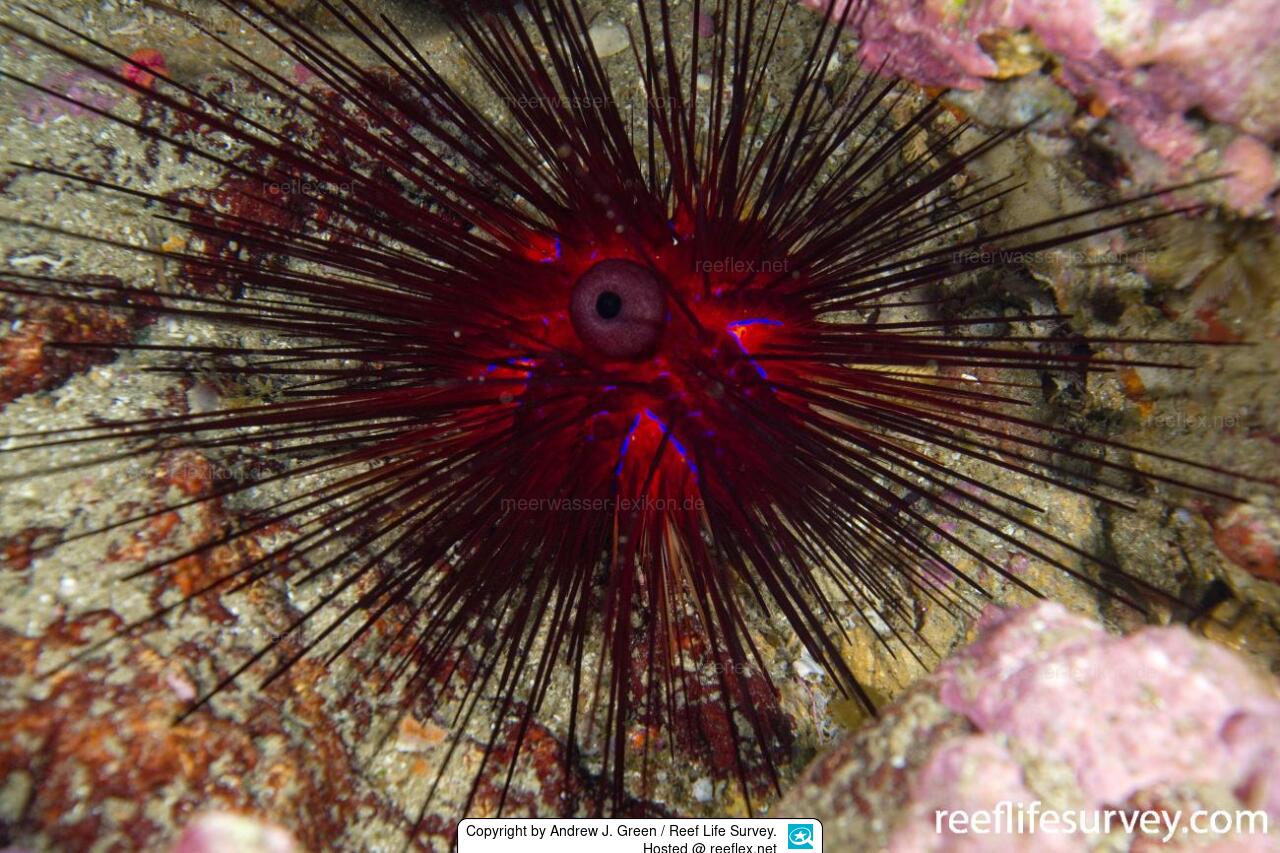
Round sea urchin. Spines long, fine, hollow; length may be more than three times
the test diameter. Both test and spines brilliant red, but spines sometimes much
darker, lighter, or banded; large bulbous anal cone, white with a black dome-
shaped tip. Live specimens with brilliant yellow, blue, or lilac lines and spots on the
upper surface. Mouth central on the lower side with five teeth. Small to moderate
size.
Found on rocky reefs, frequently in crevices during daylight, emerging at night
to graze. Limited to northeastern New Zealand and southeastern Australia, also
Kermadec, Norfolk, and Lord Howe Islands.
When observed underwater it has a dark appearance, but torchlight or sunlight reveals intense orange-red hues and, in the centre of the upper surface, a light-brown structure (the anal cone) with a black central spot. This species is found only on the deeper temperate reefs off New South Wales and New Zealand.
Diadema palmeri, the fiery sea urchin can be recognised by its bright red body and lighter coloured anal cone which has a dark spot in the centre. Feeds on algae
Their stings penetrate human skin easily and are very painful. Caution is required while working with your hands in the tank.
Round sea urchin. Spines long, fine, hollow; length may be more than three times
the test diameter. Both test and spines brilliant red, but spines sometimes much
darker, lighter, or banded; large bulbous anal cone, white with a black dome-
shaped tip. Live specimens with brilliant yellow, blue, or lilac lines and spots on the
upper surface. Mouth central on the lower side with five teeth. Small to moderate
size.
Found on rocky reefs, frequently in crevices during daylight, emerging at night
to graze. Limited to northeastern New Zealand and southeastern Australia, also
Kermadec, Norfolk, and Lord Howe Islands.
When observed underwater it has a dark appearance, but torchlight or sunlight reveals intense orange-red hues and, in the centre of the upper surface, a light-brown structure (the anal cone) with a black central spot. This species is found only on the deeper temperate reefs off New South Wales and New Zealand.
Diadema palmeri, the fiery sea urchin can be recognised by its bright red body and lighter coloured anal cone which has a dark spot in the centre. Feeds on algae


