


 ResearchGate


Info
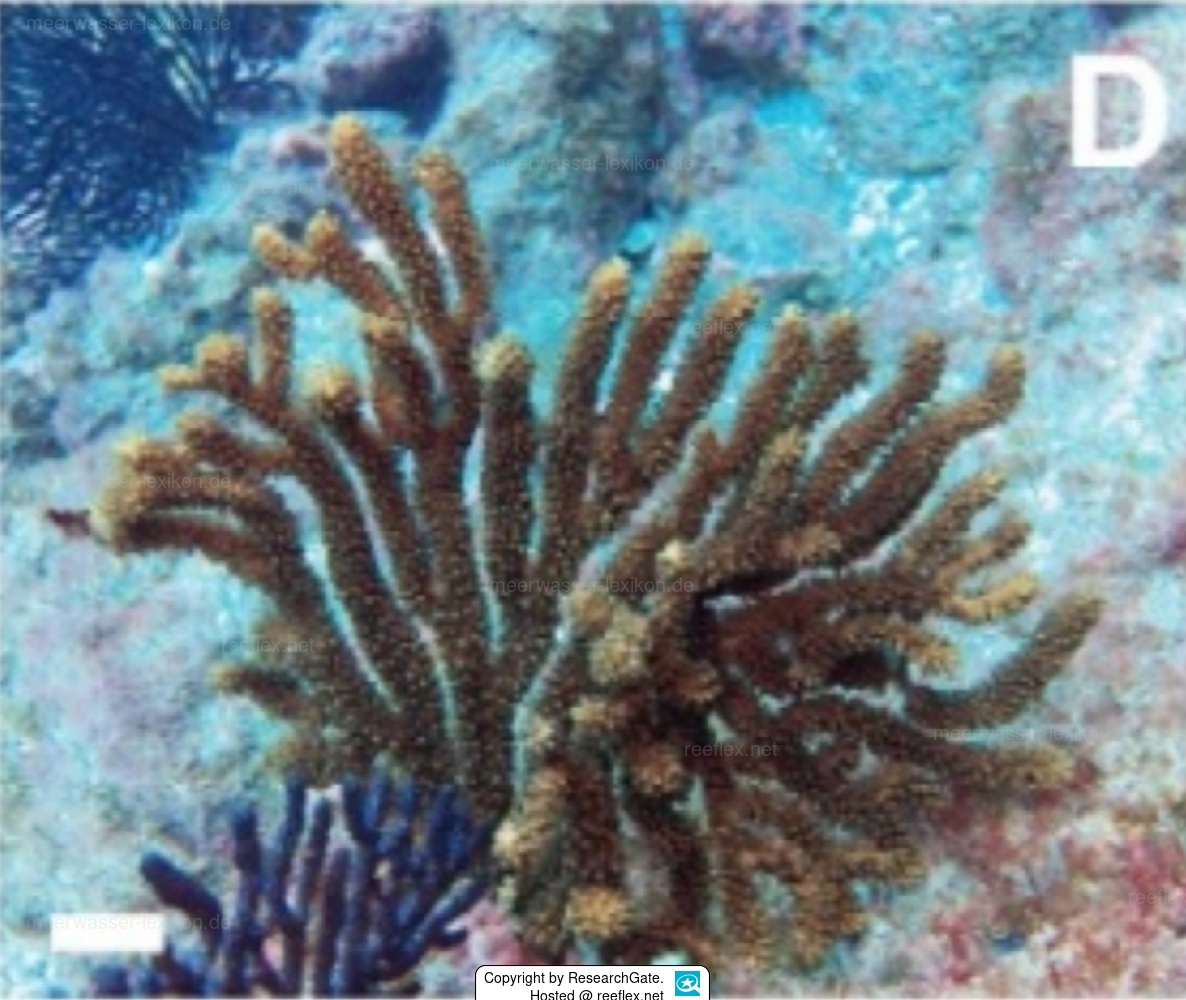
The color of the colony of Muricea crassa is dark brown.
The colonies are up to 50 cm high and up to 40 cm wide, but smaller specimens, about 30 cm high, are the majority.
The branch tips can reach a diameter of up to 15 mm, and the unbranched terminals are up to 13 cm long.
This species is very conspicuous beacause of its dark color and strong and spiny branches with broad terminal tips.
Muricea crassa has been observed in several locations in Panama, around the Pearl Islands in the Gulf of Panamá, and the deepest records are around Coiba Island in the Gulf of Chiriquí at depths of 20 - 30 meters.
Muricea crassa is not common and is sparsely distributed in patches dominated by other species.
Recommendation - the coral should be kept in a species-specific tank.
Feeding
The majority of gorgonians do not have zooxanthellae and do not live off light. Azooxanthellate gorgonians do not host symbiotic algae that produce nutrients and energy through photosynthesis.
The pumps should be switched off before feeding. In order for the gorgonian to survive in the aquarium, each individual polyp must be fed sufficiently, i.e. daily or 3-4 times a week. Without feeding, the gorgonian will not survive in the aquarium. The polyps need a certain amount of time to absorb the food (granules or dust food (Ultramarin, Cyclop Eeze) or frozen food (lobster eggs, mysis)). If shrimp and fish are present, they will try to steal the food, so it is essential to feed these cohabitants beforehand.
Newly introduced gorgonian sticks can be stimulated with a liquid food, e.g., PolypLab Polyp, to encourage the individual polyps to open. Only then can feeding be carried out.
The better the individual polyps take up the food provided, the better the growth and reproduction rates will be.
Azooxanthellate corals eat suspensions, marine snow, microplankton, and other organic matter, which is their natural food.
Literature reference:
Graham Edgar Breedy O, Guzman HM (2016)
A revision of the genus Muricea Lamouroux, 1821 (Anthozoa, Octocorallia) in the eastern Pacific. Part II.
ZooKeys 581: 1-69. doi: 10.3897/zookeys.581.7910 - #
https://zookeys.pensoft.net/articles.php?id=7910&display_type=list&element_type=8
This is an open access article distributed under the terms of the Creative Commons Attribution License (CC BY 4.0), which permits unrestricted use, distribution, and reproduction in any medium, provided the original author and source are credited.
The colonies are up to 50 cm high and up to 40 cm wide, but smaller specimens, about 30 cm high, are the majority.
The branch tips can reach a diameter of up to 15 mm, and the unbranched terminals are up to 13 cm long.
This species is very conspicuous beacause of its dark color and strong and spiny branches with broad terminal tips.
Muricea crassa has been observed in several locations in Panama, around the Pearl Islands in the Gulf of Panamá, and the deepest records are around Coiba Island in the Gulf of Chiriquí at depths of 20 - 30 meters.
Muricea crassa is not common and is sparsely distributed in patches dominated by other species.
Recommendation - the coral should be kept in a species-specific tank.
Feeding
The majority of gorgonians do not have zooxanthellae and do not live off light. Azooxanthellate gorgonians do not host symbiotic algae that produce nutrients and energy through photosynthesis.
The pumps should be switched off before feeding. In order for the gorgonian to survive in the aquarium, each individual polyp must be fed sufficiently, i.e. daily or 3-4 times a week. Without feeding, the gorgonian will not survive in the aquarium. The polyps need a certain amount of time to absorb the food (granules or dust food (Ultramarin, Cyclop Eeze) or frozen food (lobster eggs, mysis)). If shrimp and fish are present, they will try to steal the food, so it is essential to feed these cohabitants beforehand.
Newly introduced gorgonian sticks can be stimulated with a liquid food, e.g., PolypLab Polyp, to encourage the individual polyps to open. Only then can feeding be carried out.
The better the individual polyps take up the food provided, the better the growth and reproduction rates will be.
Azooxanthellate corals eat suspensions, marine snow, microplankton, and other organic matter, which is their natural food.
Literature reference:
Graham Edgar Breedy O, Guzman HM (2016)
A revision of the genus Muricea Lamouroux, 1821 (Anthozoa, Octocorallia) in the eastern Pacific. Part II.
ZooKeys 581: 1-69. doi: 10.3897/zookeys.581.7910 - #
https://zookeys.pensoft.net/articles.php?id=7910&display_type=list&element_type=8
This is an open access article distributed under the terms of the Creative Commons Attribution License (CC BY 4.0), which permits unrestricted use, distribution, and reproduction in any medium, provided the original author and source are credited.

