

 Prof. Dr. Peter Wirtz, Madeira


Info
São Tomé and Príncipe, an African island nation near the equator, is located quite close to the coasts of Gabon, Equatorial Guinea, Cameroon, and Nigeria in West Africa.
This area is an important breeding ground for sea turtles, seabirds, and whales, and the coral reefs there are home to a wide variety of marine life.
Here, at a depth of 40 meters, Dr. Roland Fricke and Dr. Peter Wirtz discovered a new, previously unknown suckerfish, also known as a shield belly, together with Corcyrogobius lubbocki Miller 1988, on an isolated rock (approx. 8 meters long, 5 meters wide) on a sandy bottom in a small crevice.
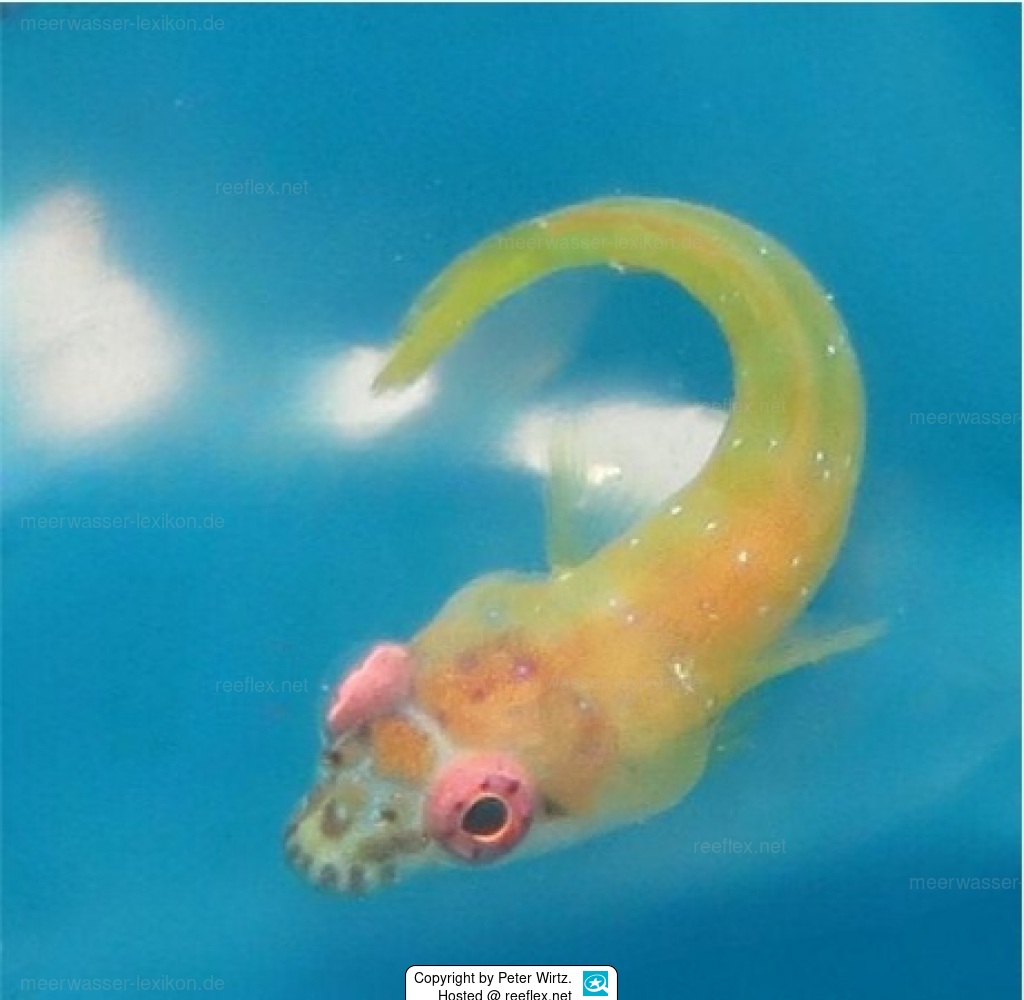
The basic coloration of the new species is yellowish, with the front and lower parts of the head speckled with light gray and dark gray.
The upper jaw has three dark gray spots on each side, and the eyes are bright pink.
Between the eyes is a white stripe connecting them, and behind each eye is a dark gray spot.
The upper side of the body has rows of light blue spots, and the sides of the body have six faint vertical yellowish stripes.
All of the fins of this small animal are yellowish.
Diplecogaster roseioculus could be a sister species of Diplecogaster tonstricula.
Etymology: The species name “roseioculus” comes from Latin, where ‘roseus’ stands for rose and “oculus” for eye; the species name refers to the pink eyes of the new species.
This area is an important breeding ground for sea turtles, seabirds, and whales, and the coral reefs there are home to a wide variety of marine life.
Here, at a depth of 40 meters, Dr. Roland Fricke and Dr. Peter Wirtz discovered a new, previously unknown suckerfish, also known as a shield belly, together with Corcyrogobius lubbocki Miller 1988, on an isolated rock (approx. 8 meters long, 5 meters wide) on a sandy bottom in a small crevice.
The basic coloration of the new species is yellowish, with the front and lower parts of the head speckled with light gray and dark gray.
The upper jaw has three dark gray spots on each side, and the eyes are bright pink.
Between the eyes is a white stripe connecting them, and behind each eye is a dark gray spot.
The upper side of the body has rows of light blue spots, and the sides of the body have six faint vertical yellowish stripes.
All of the fins of this small animal are yellowish.
Diplecogaster roseioculus could be a sister species of Diplecogaster tonstricula.
Etymology: The species name “roseioculus” comes from Latin, where ‘roseus’ stands for rose and “oculus” for eye; the species name refers to the pink eyes of the new species.

