


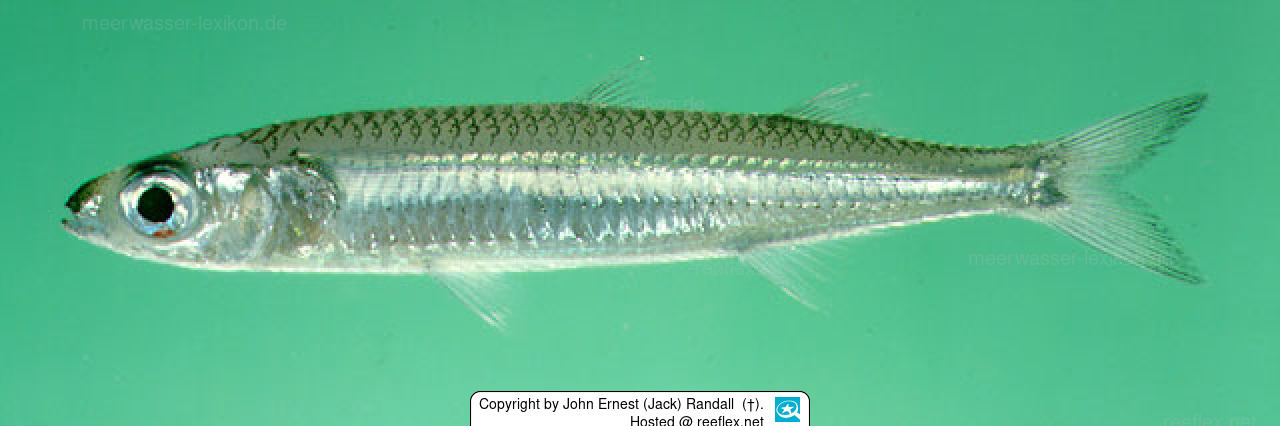
 Dr. John Ernest (Jack) Randall (†), Hawaii


Info
Life is all about eating and being eaten, which in this case refers to the food chain.
The food chain in the sea is a complex flow of energy that usually begins with phytoplankton (tiny algae) as primary producers that use sunlight.
This is followed by a multi-link chain via zooplankton, small fish, large predatory fish, and top predators such as sharks, orcas, and humans.
Destruents (bacteria) close the cycle by breaking down organic substances and decomposing them into inorganic components.
These important helpers are therefore also called decomposers.
Hypoatherina temminckii is a member of this food chain and occurs in swarms in the oceans, thus providing a rich and important buffet for larger animals in the food chain.
For humans, this fish is often used as bait for tuna fishing and is sold as bycatch from commercial fishing in regional fish markets.
Hypoatherina temminckii is very widespread and, in addition to the distribution mentioned above, also occurs in Bassas da India, an uninhabited atoll in the western Indian Ocean, west of Madagascar in the southern Mozambique Channel.
The head and body of this needlefish are greenish-gray dorsally, bright silver laterally, and the dorsal and dorsolateral scale pockets are black-edged.
A mesolateral band, shiny indigo blue with a light green upper edge, extends to the upper lobe of the caudal fin.
The ventrolateral body is dotted with small black spots; the snout and pectoral fin base are blackish and the fin membranes are hyaline.
Juvenile needlefish feed almost exclusively on zooplankton, while the species pursues a mixed feeding strategy during the rainy season (Simanjuntak et al. 2022).
The diet of adult animals includes smaller fish, shrimp, algae, insects, plankton, worms, and plants (Simanjuntak et al. 2022).
This species inhabits coastal waters and seagrass ecosystems (Simanjuntak et al. 2022).
While adult individuals also occur in other locations, juveniles are heavily dependent on seagrass beds as a rearing area that provides them with food and shelter (Simanjuntak et al. 2022).
Synonyms:
Allanetta afra (Peters, 1855) · unaccepted
Atherina afra Peters, 1855 · unaccepted
Atherina cylindrica Klunzinger, 1870 · unaccepted
Atherina gobio Klunzinger, 1884 · unaccepted
Atherina temmincki Bleeker, 1854 · unaccepted (misspelling)
Atherina temminckii Bleeker, 1854 · unaccepted
Atherina uisila Jordan & Seale, 1906 · unaccepted
Hypoatheria temminckii (Bleeker, 1854) · unaccepted (misspelling)
Hypoatherina cylindrica (Klunzinger, 1870) · unaccepted
Hypoatherina gobio (Klunzinger, 1884) · unaccepted
Hypoatherina uisila (Jordan & Seale, 1906) · unaccepted
Hypotherina temminckii (Bleeker, 1854) · unaccepted > misspelling - incorrect subsequent spelling
Stenatherina temmincki (Bleeker, 1854) · unaccepted (misspelling)
Stenatherina temminckii (Bleeker, 1854) · unaccepted
The food chain in the sea is a complex flow of energy that usually begins with phytoplankton (tiny algae) as primary producers that use sunlight.
This is followed by a multi-link chain via zooplankton, small fish, large predatory fish, and top predators such as sharks, orcas, and humans.
Destruents (bacteria) close the cycle by breaking down organic substances and decomposing them into inorganic components.
These important helpers are therefore also called decomposers.
Hypoatherina temminckii is a member of this food chain and occurs in swarms in the oceans, thus providing a rich and important buffet for larger animals in the food chain.
For humans, this fish is often used as bait for tuna fishing and is sold as bycatch from commercial fishing in regional fish markets.
Hypoatherina temminckii is very widespread and, in addition to the distribution mentioned above, also occurs in Bassas da India, an uninhabited atoll in the western Indian Ocean, west of Madagascar in the southern Mozambique Channel.
The head and body of this needlefish are greenish-gray dorsally, bright silver laterally, and the dorsal and dorsolateral scale pockets are black-edged.
A mesolateral band, shiny indigo blue with a light green upper edge, extends to the upper lobe of the caudal fin.
The ventrolateral body is dotted with small black spots; the snout and pectoral fin base are blackish and the fin membranes are hyaline.
Juvenile needlefish feed almost exclusively on zooplankton, while the species pursues a mixed feeding strategy during the rainy season (Simanjuntak et al. 2022).
The diet of adult animals includes smaller fish, shrimp, algae, insects, plankton, worms, and plants (Simanjuntak et al. 2022).
This species inhabits coastal waters and seagrass ecosystems (Simanjuntak et al. 2022).
While adult individuals also occur in other locations, juveniles are heavily dependent on seagrass beds as a rearing area that provides them with food and shelter (Simanjuntak et al. 2022).
Synonyms:
Allanetta afra (Peters, 1855) · unaccepted
Atherina afra Peters, 1855 · unaccepted
Atherina cylindrica Klunzinger, 1870 · unaccepted
Atherina gobio Klunzinger, 1884 · unaccepted
Atherina temmincki Bleeker, 1854 · unaccepted (misspelling)
Atherina temminckii Bleeker, 1854 · unaccepted
Atherina uisila Jordan & Seale, 1906 · unaccepted
Hypoatheria temminckii (Bleeker, 1854) · unaccepted (misspelling)
Hypoatherina cylindrica (Klunzinger, 1870) · unaccepted
Hypoatherina gobio (Klunzinger, 1884) · unaccepted
Hypoatherina uisila (Jordan & Seale, 1906) · unaccepted
Hypotherina temminckii (Bleeker, 1854) · unaccepted > misspelling - incorrect subsequent spelling
Stenatherina temmincki (Bleeker, 1854) · unaccepted (misspelling)
Stenatherina temminckii (Bleeker, 1854) · unaccepted


