



 Wiley Online Library


Info
In May 2026, two new species of wrasse were described and published: Labroides inopinatus and Labroides flammulatus, the Zinnober wrasse.
Habitat and Distribution.
Labroides inopinatus is currently known only from type specimens collected at depths between 60 and 145 meters in Izu Oceanic Park in Sagami Bay (Japan), at Holmes and Flora Reefs in the Coral Sea (Queensland, Australia), and at Boulari Pass in New Caledonia.
Juveniles were also photographed at a depth of 40 meters in Izu Oceanic Park.
The species was also observed in deep mesophotic reefs in Wakatobi, in southeastern Sulawesi, Indonesia, at a depth of about 110 meters, but was not collected (S.J. Rowley, pers. comm., 2025).
Initial phase
Coloration of sexually mature individuals and juveniles in the wild. Similar, but with a base color ranging from dark gray to gray-brown
Coloration in the terminal phase:
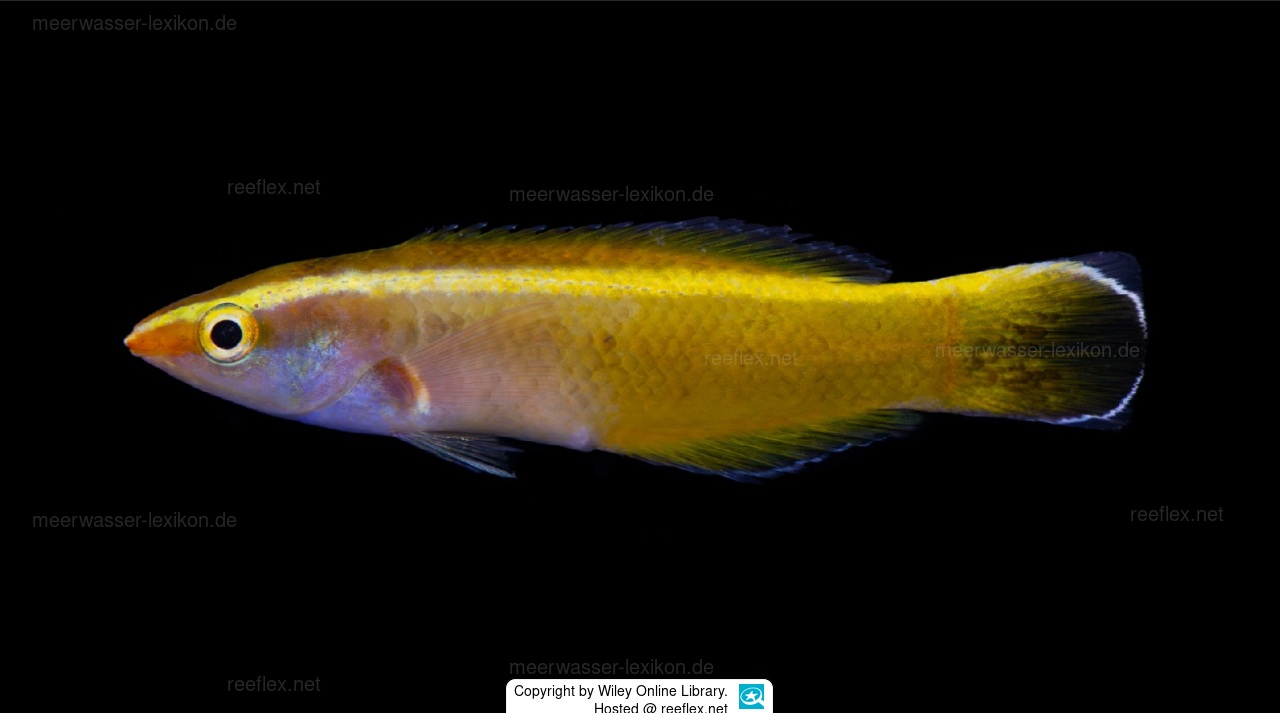
The upper half of the head and the base color of the body are mustard yellow to brown; the lower part of the head is silver-gray and transitions to light gray at the base of the neck and on the chest.
The snout has a horizontal orange-brown stripe running from the side of the upper lip to the front edge of the eye socket, the width of which is roughly equal to that of the pupil
The stripe runs horizontally through the eye socket, with its width increasing slightly toward the free upper edge of the gill cover; the stripe continues beyond the gill cover and blends into the body’s base color; the snout has a second, cream-colored to silvery-white stripe that originates from the back of the upper lip, curves slightly, and runs over the back of the eye socket, across the free upper edge of the gill cover to the upper edge of the caudal fin.
The dorsal fin is dark mustard yellow, distally dark hyaline; The anal fin is similar to the dorsal fin; the caudal fin is dark yellow, becoming increasingly sooty toward the tip; the caudal fin has a narrow, bright white, sickle-shaped margin; the upper part of the sickle-shaped margin continues from the end of the cream-colored to silvery-white body stripe; the upper and lower lobes of the caudal fin are translucent beyond the margin.
The pelvic fins are white to translucent gray, the pectoral fins hyaline (Figs. 34, 35A, 34D–F).
Notes.
A pair of Cymothoidae isopods (AMS P.1102936; Fig. 35C) was removed from the left gill chamber of one of the paratypes (AMS I.51732-002).
The female appears to be pregnant, although it is unclear whether the pair had mated within the host’s gill chamber.
No significant tissue damage was observed during the removal and examination of the gill tissue.
Etymology.
The species name is derived from the Latin adjective “inopinatus,” meaning “unexpected” or “unforeseen,” and refers to the surprising discovery of a new species of cleaner wrasse apparently living at great depths. The common name refers to its yellowish coloration when alive.
We would like to extend our special thanks to Dr. Yi-Kai Tea of the Australian Museum for the first photograph of this new cleaner wrasse species.
Habitat and Distribution.
Labroides inopinatus is currently known only from type specimens collected at depths between 60 and 145 meters in Izu Oceanic Park in Sagami Bay (Japan), at Holmes and Flora Reefs in the Coral Sea (Queensland, Australia), and at Boulari Pass in New Caledonia.
Juveniles were also photographed at a depth of 40 meters in Izu Oceanic Park.
The species was also observed in deep mesophotic reefs in Wakatobi, in southeastern Sulawesi, Indonesia, at a depth of about 110 meters, but was not collected (S.J. Rowley, pers. comm., 2025).
Initial phase
Coloration of sexually mature individuals and juveniles in the wild. Similar, but with a base color ranging from dark gray to gray-brown
Coloration in the terminal phase:
The upper half of the head and the base color of the body are mustard yellow to brown; the lower part of the head is silver-gray and transitions to light gray at the base of the neck and on the chest.
The snout has a horizontal orange-brown stripe running from the side of the upper lip to the front edge of the eye socket, the width of which is roughly equal to that of the pupil
The stripe runs horizontally through the eye socket, with its width increasing slightly toward the free upper edge of the gill cover; the stripe continues beyond the gill cover and blends into the body’s base color; the snout has a second, cream-colored to silvery-white stripe that originates from the back of the upper lip, curves slightly, and runs over the back of the eye socket, across the free upper edge of the gill cover to the upper edge of the caudal fin.
The dorsal fin is dark mustard yellow, distally dark hyaline; The anal fin is similar to the dorsal fin; the caudal fin is dark yellow, becoming increasingly sooty toward the tip; the caudal fin has a narrow, bright white, sickle-shaped margin; the upper part of the sickle-shaped margin continues from the end of the cream-colored to silvery-white body stripe; the upper and lower lobes of the caudal fin are translucent beyond the margin.
The pelvic fins are white to translucent gray, the pectoral fins hyaline (Figs. 34, 35A, 34D–F).
Notes.
A pair of Cymothoidae isopods (AMS P.1102936; Fig. 35C) was removed from the left gill chamber of one of the paratypes (AMS I.51732-002).
The female appears to be pregnant, although it is unclear whether the pair had mated within the host’s gill chamber.
No significant tissue damage was observed during the removal and examination of the gill tissue.
Etymology.
The species name is derived from the Latin adjective “inopinatus,” meaning “unexpected” or “unforeseen,” and refers to the surprising discovery of a new species of cleaner wrasse apparently living at great depths. The common name refers to its yellowish coloration when alive.
We would like to extend our special thanks to Dr. Yi-Kai Tea of the Australian Museum for the first photograph of this new cleaner wrasse species.

