


 Georgina Jones (CC-BY-SA), Cape Town

Info
Boopsoidea inornata is considered a good food fish, so it is often targeted by sport fishermen and used as bait for larger predatory fish such as tuna.
This monotypic schooling fish is hermaphroditic and is also plagued by a variety of parasites, including representatives of Myxozoa, Monogenea, Digenea, Cestoda, Nematoda, Copepoda, Isopoda, and Stephanostomum.
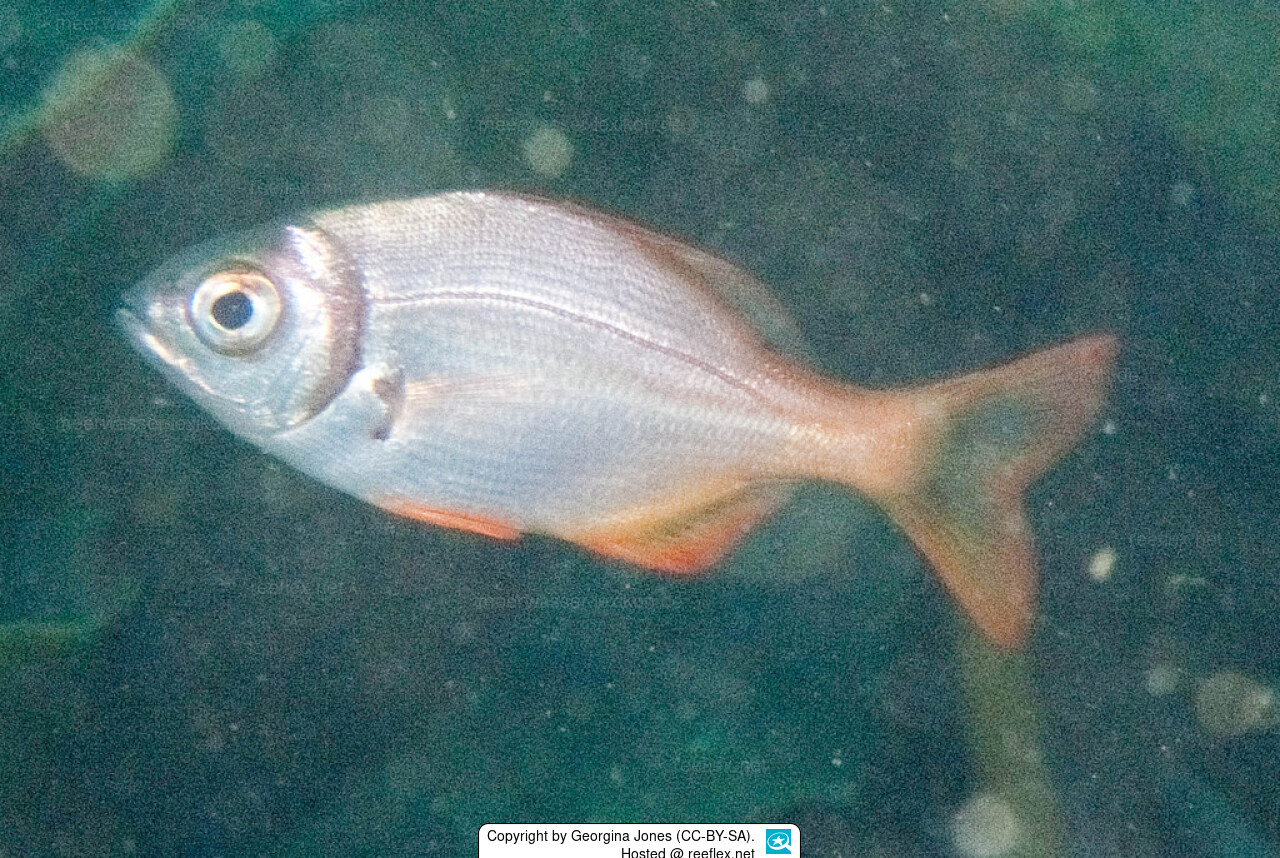
Boopsoidea inornata has an oval, silvery body with a small head, a dark, curved line extending from behind the head to the rear edge of the gill covers, and a faint dark stripe along the body’s midline that extends forward from the base of the tail.
A brass-colored tint is visible at the base of the tail, and a dark lateral line runs along the rear part of the body.
This sympatric species tolerates only specific maximum thermal stress limits, which average between 9 °C and 25 °C.
Habitat:
Boopsoidea inornata is usually found in schools near scattered and shallow reefs; adult sea bream feed benthically on crustaceans, tunicates, algae, polychaetes, bryozoans, and mollusks, with the predominant crustaceans consisting of amphipods, decapods, isopods, and mysids (Wood and Cowley 2012) .
Habitat and Ecology
Boopsoidea inornata is commonly found in large schools near scattered, high- and shallow-relief reefs (Trow 1982, Buxton and Smale 1984, van der Elst 1988, Burger 1990, Smith 2005).
Juveniles inhabit shallow, calcareous algae-covered subtidal reefs (Buxton and Smale 1984, Beckley and Buxton 1989, Burger 1990, Smith 2005).
The eggs of this species are pelagic and have been found in the shelf waters of Tsitskamma National Park (Wood 1998, Wood et al. 2000).
Reproduction
Boopsoidea inornata exhibits gonochoristic reproduction (Garratt 1986) and spawns during the spring and summer months (Buxton and Smale 1984).
Spawning occurs in subtidal reefs in the southwest and southeast of the Cape (Jayiya et al. 2000), but is likely to occur throughout the species’ range (B. Mann, ORI, personal observation).
All individuals >14 cm (SL) are sexually mature (Trow 1982).
Etymology:
The species name “inornata” was chosen simply, without further explanation, possibly in reference to the absence of spots and stripes.
The fish was first described as having a dark upper body with a pink sheen, a white underside, dark fins, and a yellow iris.
Synonym:
Pagrus holubi Steindachner, 1881
Synonym:
Pagrus holubi Steindachner, 1881
This monotypic schooling fish is hermaphroditic and is also plagued by a variety of parasites, including representatives of Myxozoa, Monogenea, Digenea, Cestoda, Nematoda, Copepoda, Isopoda, and Stephanostomum.
Boopsoidea inornata has an oval, silvery body with a small head, a dark, curved line extending from behind the head to the rear edge of the gill covers, and a faint dark stripe along the body’s midline that extends forward from the base of the tail.
A brass-colored tint is visible at the base of the tail, and a dark lateral line runs along the rear part of the body.
This sympatric species tolerates only specific maximum thermal stress limits, which average between 9 °C and 25 °C.
Habitat:
Boopsoidea inornata is usually found in schools near scattered and shallow reefs; adult sea bream feed benthically on crustaceans, tunicates, algae, polychaetes, bryozoans, and mollusks, with the predominant crustaceans consisting of amphipods, decapods, isopods, and mysids (Wood and Cowley 2012) .
Habitat and Ecology
Boopsoidea inornata is commonly found in large schools near scattered, high- and shallow-relief reefs (Trow 1982, Buxton and Smale 1984, van der Elst 1988, Burger 1990, Smith 2005).
Juveniles inhabit shallow, calcareous algae-covered subtidal reefs (Buxton and Smale 1984, Beckley and Buxton 1989, Burger 1990, Smith 2005).
The eggs of this species are pelagic and have been found in the shelf waters of Tsitskamma National Park (Wood 1998, Wood et al. 2000).
Reproduction
Boopsoidea inornata exhibits gonochoristic reproduction (Garratt 1986) and spawns during the spring and summer months (Buxton and Smale 1984).
Spawning occurs in subtidal reefs in the southwest and southeast of the Cape (Jayiya et al. 2000), but is likely to occur throughout the species’ range (B. Mann, ORI, personal observation).
All individuals >14 cm (SL) are sexually mature (Trow 1982).
Etymology:
The species name “inornata” was chosen simply, without further explanation, possibly in reference to the absence of spots and stripes.
The fish was first described as having a dark upper body with a pink sheen, a white underside, dark fins, and a yellow iris.
Synonym:
Pagrus holubi Steindachner, 1881
Synonym:
Pagrus holubi Steindachner, 1881


