


 Journal of the Ocean Science Foundation


Info
The initial description of Fusigobius transversus was based on a female holotype measuring 26.6 mm SL in June 2026.
The new species is currently known only from the type locality in Milne Bay Province, Papua New Guinea, but is likely to be more widely distributed on deeper mesophotic reefs throughout the eastern Indian Ocean. The holotype was collected on a sandy bottom beneath a rock outcrop on a steep outer reef drop-off at a depth of 62 meters.
Location: Papua New Guinea, Milne Bay Province, near East Cape, a submerged reef 0.9 km southeast of Boia Boia Waga Island and 3 km northeast of the mainland near East Cape, at the “Cobb’s Cliff” dive site.
Description:
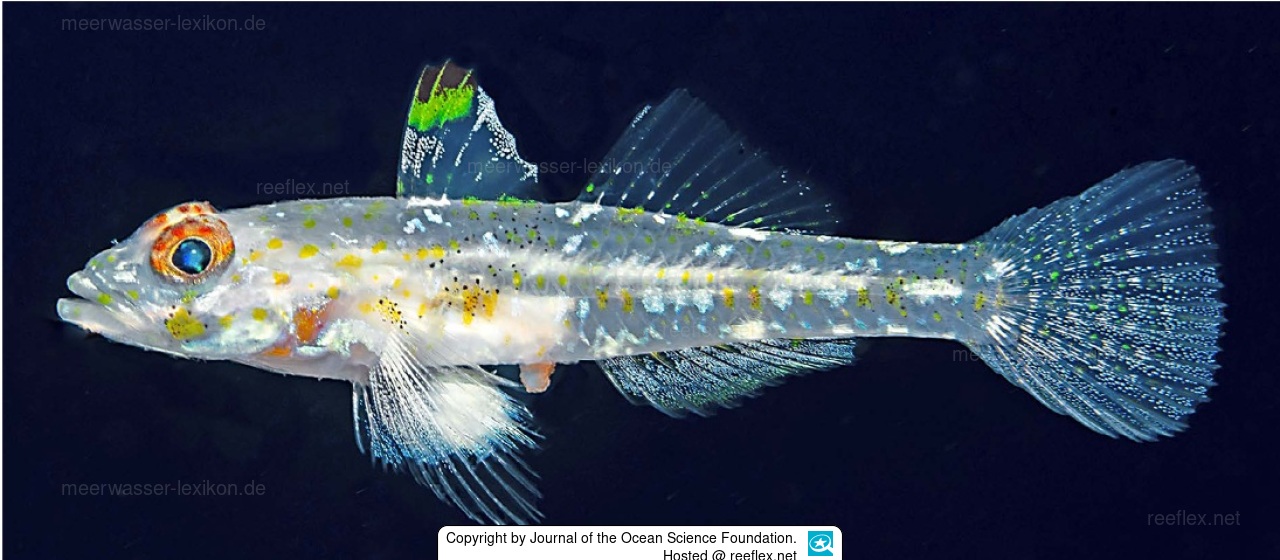
The goby’s head and body are semi-translucent with scattered orange spots and white speckles of varying sizes, most of which are significantly smaller than the pupil, with the exception of a relatively large spot on the lower cheek directly below the eye, a reddish -orange spot on the lower half of the gill cover, and an irregularly shaped spot in the middle of the side below the first dorsal fin
On the sides of the head and body there are scattered, tiny melanophores, most clearly visible on the cheek below the center of the eye, at the base of the uppermost pectoral fin rays, on the anterior part of the body between the base of the first dorsal fin and the midline of the body, and on the sides of the caudal peduncle.
The central fins are predominantly translucent to whitish without any conspicuous markings, with the exception of the outer half of the first dorsal fin between the first four spines, which features a distinctive, rectangular, greenish-yellow, slightly slanted band as well as a broad, brown outer margin on the first three membranes.
The rest of the fin has dull white areas below the colored band and along the posterior fin margin; the second dorsal fin is translucent, except for the basal half of each fin ray, which has a few tiny white and yellow spots.
The caudal fin has numerous tiny white spots and stripes, as well as four or five transverse rows of small yellow spots.
The anal fin is predominantly whitish with a faint yellow marginal band and yellow stripes along the base of the third, sixth, and last segmented rays.
The pectoral fins are translucent, except for the basal portion of the 9 lowest rays, which are white; the corresponding membranes are densely spotted with white, with yellow markings at the base of the uppermost rays.
A distinctive, obliquely running white band extends across the center of the pectoral fin base, merging into a curved, silvery-white band at the lower edge of the gill cover.
The pelvic fins are predominantly white; the iris is yellowish-red with 4 or 5 relatively inconspicuous reddish, spoke-like markings on the dorsal scleral surface.
Note:
Several species from relatively deep waters (30–114 meters) exhibit a well-defined transverse pattern, suggesting a connection between deeper habitats and the papillae pattern.
Etymology.
The new goby species was named “transversus” (Latin for “transverse”) in reference to its most striking feature, the transverse arrangement of the sensory papillae on the cheeks.
REFERENCE:
Allen, G.R., Erdmann, M.V., Brooks, W.M., & Ichida, N.K. (2026) A new species of mesophotic Fusigobius goby (Teleostei: Gobiidae) from eastern Papua New Guinea. Journal of the Ocean Science Foundation, 46, 63–70.
https://doi.org/10.5281/zenodo.20587166
Publication date: June 7, 2026
Citation:
Allen, G.R., Erdmann, M.V., Brooks, W.M. & Ichida, N.K. (2026) A new species of mesophotic Fusigobius goby (Teleostei: Gobiidae) from eastern Papua New Guinea. Journal of the Ocean Science Foundation, 46, 63-70.
https://doi.org/10.5281/zenodo.20587166
publication date: 7 June 2026
The new species is currently known only from the type locality in Milne Bay Province, Papua New Guinea, but is likely to be more widely distributed on deeper mesophotic reefs throughout the eastern Indian Ocean. The holotype was collected on a sandy bottom beneath a rock outcrop on a steep outer reef drop-off at a depth of 62 meters.
Location: Papua New Guinea, Milne Bay Province, near East Cape, a submerged reef 0.9 km southeast of Boia Boia Waga Island and 3 km northeast of the mainland near East Cape, at the “Cobb’s Cliff” dive site.
Description:
The goby’s head and body are semi-translucent with scattered orange spots and white speckles of varying sizes, most of which are significantly smaller than the pupil, with the exception of a relatively large spot on the lower cheek directly below the eye, a reddish -orange spot on the lower half of the gill cover, and an irregularly shaped spot in the middle of the side below the first dorsal fin
On the sides of the head and body there are scattered, tiny melanophores, most clearly visible on the cheek below the center of the eye, at the base of the uppermost pectoral fin rays, on the anterior part of the body between the base of the first dorsal fin and the midline of the body, and on the sides of the caudal peduncle.
The central fins are predominantly translucent to whitish without any conspicuous markings, with the exception of the outer half of the first dorsal fin between the first four spines, which features a distinctive, rectangular, greenish-yellow, slightly slanted band as well as a broad, brown outer margin on the first three membranes.
The rest of the fin has dull white areas below the colored band and along the posterior fin margin; the second dorsal fin is translucent, except for the basal half of each fin ray, which has a few tiny white and yellow spots.
The caudal fin has numerous tiny white spots and stripes, as well as four or five transverse rows of small yellow spots.
The anal fin is predominantly whitish with a faint yellow marginal band and yellow stripes along the base of the third, sixth, and last segmented rays.
The pectoral fins are translucent, except for the basal portion of the 9 lowest rays, which are white; the corresponding membranes are densely spotted with white, with yellow markings at the base of the uppermost rays.
A distinctive, obliquely running white band extends across the center of the pectoral fin base, merging into a curved, silvery-white band at the lower edge of the gill cover.
The pelvic fins are predominantly white; the iris is yellowish-red with 4 or 5 relatively inconspicuous reddish, spoke-like markings on the dorsal scleral surface.
Note:
Several species from relatively deep waters (30–114 meters) exhibit a well-defined transverse pattern, suggesting a connection between deeper habitats and the papillae pattern.
Etymology.
The new goby species was named “transversus” (Latin for “transverse”) in reference to its most striking feature, the transverse arrangement of the sensory papillae on the cheeks.
REFERENCE:
Allen, G.R., Erdmann, M.V., Brooks, W.M., & Ichida, N.K. (2026) A new species of mesophotic Fusigobius goby (Teleostei: Gobiidae) from eastern Papua New Guinea. Journal of the Ocean Science Foundation, 46, 63–70.
https://doi.org/10.5281/zenodo.20587166
Publication date: June 7, 2026
Citation:
Allen, G.R., Erdmann, M.V., Brooks, W.M. & Ichida, N.K. (2026) A new species of mesophotic Fusigobius goby (Teleostei: Gobiidae) from eastern Papua New Guinea. Journal of the Ocean Science Foundation, 46, 63-70.
https://doi.org/10.5281/zenodo.20587166
publication date: 7 June 2026

